
We’ve spent the past year working across dozens of software teams — from early-stage SaaS startups to mid-market product companies — helping them plan, build, and ship AI-powered features. What we’ve observed isn’t theoretical. It’s ground-level, real-world signal from organisations navigating the AI transition right now.
The picture is clear: the companies moving fast on AI aren’t just gaining a competitive edge — they’re locking others out. And the ones stalling? The cost of waiting is compounding every single quarter.
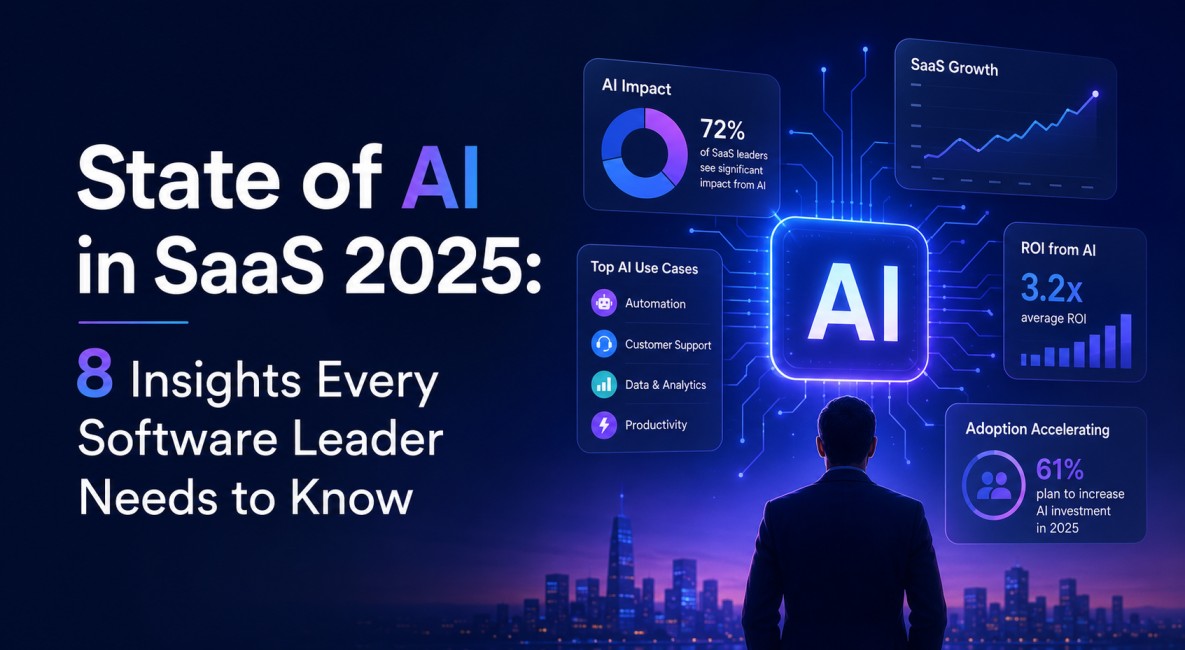
Here are the 8 most important insights from the current state of AI in SaaS — and what they mean for your roadmap.
78%
of SaaS buyers now expect AI features at demo stage
4x
faster shipping for AI-native teams vs legacy teams
Q3 ’25
estimated close of the early-mover ROI window
62%
of AI pilots fail due to poor data readiness
In this article
- AI is no longer a differentiator — it’s the baseline
- The winners aren’t building AI — they’re embedding it
- Data quality is the new competitive moat
- AI copilots are replacing entire product categories
- Small teams are outpacing large ones
- Prompt engineering is a core engineering skill now
- AI trust is the next UX frontier
- The ROI window is closing fast
AI is no longer a differentiator — it’s the baseline
Two years ago, shipping an AI-powered feature was a product moment worth a press release. Today, buyers walk into demos with AI on their checklist. If it’s not there, the conversation ends faster than you think.
We’re seeing this consistently across verticals — from HR tech to DevOps tooling. The question has shifted from “do you have AI?” to “how deeply is AI integrated into your core workflow?”
The companies still treating AI as a bolt-on feature aren’t just behind on the roadmap. They’re losing deals at the evaluation stage to competitors who made the investment 12–18 months ago.
The winners aren’t building AI — they’re embedding it
There’s a critical difference between adding AI features and rewiring your product around AI. The former looks like a chatbot widget in the corner. The latter looks like Notion, Linear, or Figma — where AI is woven into every action, not bolted onto the sidebar.
The most successful SaaS teams we work with don’t ask “where can we add AI?” They ask “which of our core workflows becomes 10x better if AI is native to it?” That’s a fundamentally different design question — and it produces fundamentally different products.
Embedding AI means: it lives in the critical path of your user’s daily workflow. It reduces friction at the exact moment users need it. It doesn’t require users to switch context to use it.
Data quality is the new competitive moat
Every SaaS company now has access to the same foundation models — GPT-4, Claude, Gemini. The LLMs themselves aren’t the moat. Your data is.
The companies pulling ahead are the ones with clean, structured, proprietary data that can be used to fine-tune, embed, or retrieve-augment their AI layer. A CRM platform with 5 years of clean customer interaction data will build a significantly more accurate AI assistant than a competitor starting fresh — even if both use the same base model.
This has a direct implication for teams building AI today: data infrastructure is product infrastructure. Investing in data pipelines, labelling workflows, and schema standardisation isn’t a backend task — it’s a competitive strategy.
- Audit your existing data for completeness and structure
- Identify which datasets are proprietary and not available to competitors
- Build labelling and feedback loops into your product now — not after launch
- Treat your data schema as a product decision, not an engineering one
AI copilots are replacing entire product categories
Products that used to be standalone point solutions — SEO tools, analytics dashboards, customer support software, content tools — are rapidly becoming AI features inside larger, more integrated platforms.
Why pay for a standalone keyword research tool when your CMS has an AI writing assistant that does it natively? Why use a separate analytics product when your data warehouse surfaces insights automatically?
This is creating a two-speed market: platforms that absorb capabilities, and point solutions that get commoditised. If your product is a point solution, the strategic question isn’t “how do we add AI?” — it’s “how do we deepen integration with the platforms our users live in, before they make us redundant?”
Small teams are outpacing large ones
One of the most striking patterns we’re seeing: a 5-person AI-native team is consistently shipping faster than a 50-person legacy team. Not because they’re smarter. Because they’ve restructured their entire workflow around AI from the ground up.
AI-native teams use tools like Cursor for coding, Notion AI for documentation, Claude for code review and spec writing, and custom LLM pipelines for QA. The result is a multiplication of individual output that legacy processes simply can’t match.
Larger organisations aren’t disadvantaged by size — they’re disadvantaged by process inertia. The teams within larger companies that are winning are the ones that have been given permission to rebuild their workflows from scratch, not retrofit AI into existing ones.
Prompt engineering is a core engineering skill now
Twelve months ago, prompt engineering was a curiosity. Today, the companies pulling ahead are treating it as a core discipline — building prompt libraries, version-controlling their prompts, running A/B tests on outputs, and creating fine-tuning pipelines.
The teams that treat prompts as throwaway strings are producing inconsistent, unreliable AI outputs. The teams that treat prompts as production code — with documentation, testing, and iteration — are building AI features that actually work in the hands of real users.
Practically, this means:
- Prompts should be versioned and stored in your codebase, not hardcoded
- Every AI feature should have a defined evaluation framework before launch
- Engineers should have fluency in few-shot techniques, chain-of-thought prompting, and retrieval-augmented generation (RAG)
- Quality assurance for AI outputs should be a separate, explicit process
AI trust is the next UX frontier
Users want AI features. But they don’t trust outputs they can’t verify, can’t explain, or can’t override. This tension — between AI’s speed and users’ need for control — is becoming the defining UX challenge of 2025.
The products winning on trust aren’t hiding their AI layer. They’re surfacing it. They show confidence scores. They give users the ability to inspect reasoning. They make it obvious when an output is AI-generated vs human-authored. They offer override mechanisms that don’t feel like a defeat.
Explainability is no longer a nice-to-have. In regulated sectors — legal, finance, healthcare — it’s quickly becoming a procurement requirement. And in consumer SaaS, it’s becoming a trust signal that differentiates premium from commodity.
The ROI window is closing fast
Early movers in AI — the companies that invested in AI infrastructure and workflows in 2023 and 2024 — are now compounding their advantage. Every quarter they’ve been operating with AI-powered teams, they’ve been learning, iterating, and accumulating proprietary data. That lead is structural, not tactical.
The window to get meaningfully ahead is narrowing. In 12–18 months, the baseline expectation of AI capability in SaaS products will be so high that simply meeting it won’t create differentiation — it will just be the cost of staying in the market.
The ROI question has also inverted: it’s no longer “what’s the return on investing in AI?” — it’s “what’s the cost of not investing?” For most teams, that cost is already measurable: in slower shipping, in deals lost to AI-native competitors, in engineers spending hours on tasks that should take minutes.
What this means for your team
The 8 insights above aren’t predictions. They’re patterns we’re observing right now, across real teams, in real product organisations. The common thread running through all of them is urgency — not panic, but a clear-eyed recognition that the AI transition in SaaS is not a future event. It’s the current operating environment.
The most important question you can ask your team this week isn’t “should we be doing AI?” It’s “given everything we know today, what’s the single highest-leverage AI bet we can make in the next 90 days?”
That might be an AI feature your users are asking for. It might be an internal workflow that AI could cut from 4 hours to 20 minutes. It might be a data infrastructure investment that builds your long-term moat. But it needs to be something concrete, scoped, and started — not deferred to a future roadmap cycle.
At ilogix, we work with software teams to turn exactly these decisions into shipped products. If you’re navigating any of the challenges above, we’d be glad to share what’s working — and what isn’t.
Frequently asked questions
- https://www.mckinsey.com/capabilities/quantumblack/our-insights/the-state-of-ai
- https://www.gartner.com/en/newsroom/press-releases/2025-08-05-gartner-hype-cycle-identifies-top-ai-innovations-in-2025
- https://www.netguru.com/blog/ai-adoption-statistics
- https://zylo.com/blog/saas-statistics
- https://gitnux.org/ai-in-the-saas-industry-statistics/
- https://www.bettercloud.com/resources/state-of-saas/
- https://www.gartner.com/en/newsroom/press-releases/2026-03-30-gartner-predicts-by-2028-explainable-ai-will-drive-llm-observability-investments-to-50-percent-for-secure-genai-deployment
- https://www.mckinsey.com/capabilities/strategy-and-corporate-finance/our-insights/where-ai-will-create-value-and-where-it-wont