
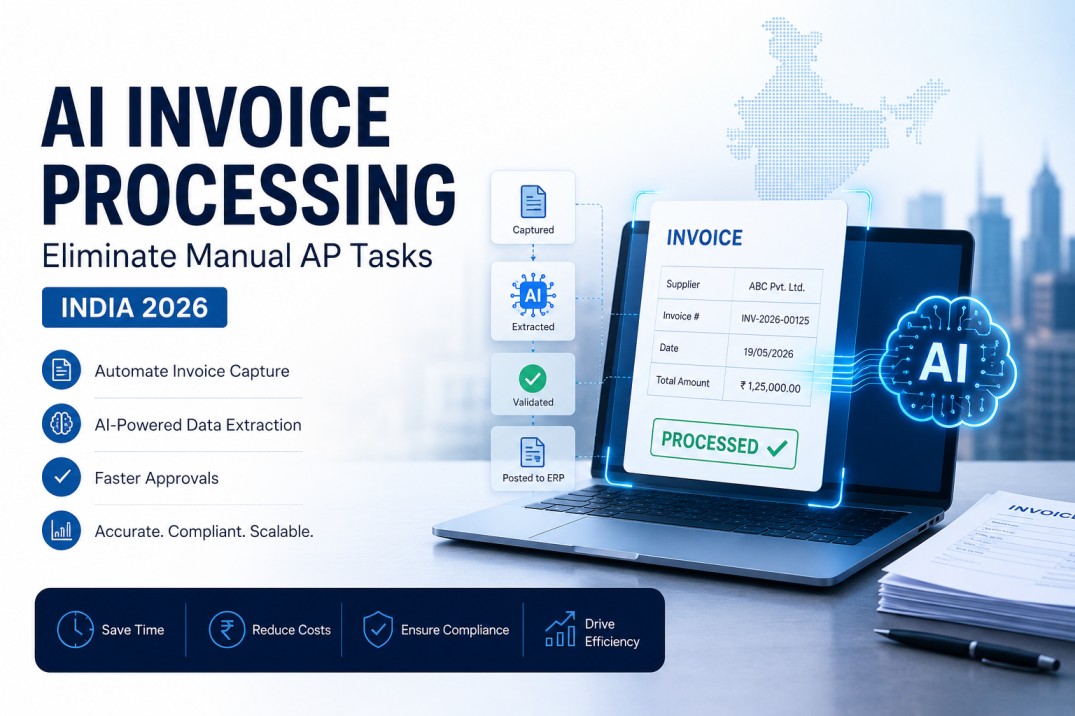
For CFOs and finance managers grappling with invoice backlogs, compliance pressures, and the ever-present risk of duplicate payments, AI invoice processing has evolved from a competitive advantage to an operational necessity. According to a recent Deloitte India survey, 73% of Indian enterprises now consider AP automation a critical priority, with AI-driven solutions leading the charge.

The Manual AP Crisis Facing Indian Businesses
Indian businesses process an average of 12,000 to 50,000 invoices monthly, depending on their scale. Traditional manual processing methods cost between ₹150-₹300 per invoice when factoring in labor, error correction, and delayed payment penalties.
The pain points are well-documented:
- Processing delays: Manual invoice handling takes 7-15 days on average, straining vendor relationships
- Error rates: Human data entry carries a 1-3% error rate, translating to thousands of mistakes monthly
- Duplicate payments: APQC research indicates that 0.1-0.8% of all invoices result in duplicate payments—costing large enterprises crores annually
- Compliance gaps: GST reconciliation and audit trails become nightmares with paper-based systems
- Scalability issues: Hiring and training AP staff can’t keep pace with business growth
These challenges compound during India’s financial year-end periods (March) and festive seasons when invoice volumes spike by 200-300%.
How AI Invoice Processing Works in 2026
Modern AI invoice processing leverages a sophisticated stack of technologies that have matured significantly over the past two years:
Intelligent Document Processing (IDP)
AI-powered optical character recognition (OCR) now achieves 99.5%+ accuracy on Indian invoices, even handling regional languages, varying formats, and poor-quality scans. Unlike legacy OCR systems, 2026’s IDP solutions use machine learning models trained on millions of Indian business documents, understanding context rather than just extracting text.
Natural Language Processing (NLP)
NLP engines comprehend invoice content semantically, extracting vendor names, GST numbers, line items, tax breakdowns, and payment terms regardless of format variations. They can distinguish between similar-looking fields and flag anomalies that human reviewers might miss.
Machine Learning Validation
AI models cross-reference extracted data against purchase orders, contracts, and historical payment records in real-time. They automatically validate three-way matches (PO-Invoice-GRN) and identify discrepancies requiring human review—but only for the 5-10% of exceptions rather than 100% of invoices.
Robotic Process Automation (RPA)
Once validated, RPA bots automatically route invoices through approval workflows, update ERP systems (SAP, Oracle, JDE), and schedule payments. At iLogix Digital India, our AI automation solutions built on platforms like n8n, Make, and Zapier create custom workflows that integrate seamlessly with existing enterprise systems.
The 90% Reduction: Breaking Down the Numbers
When we say AI eliminates 90% of manual AP tasks, here’s what that means in practice for a mid-sized Indian enterprise processing 20,000 invoices monthly:
| Task | Manual Hours (Before) | AI-Assisted Hours (After) | Reduction |
|---|---|---|---|
| Data entry | 800 | 40 | 95% |
| Validation & matching | 600 | 80 | 87% |
| Exception handling | 400 | 120 | 70% |
| Approval routing | 200 | 10 | 95% |
| ERP updates | 300 | 15 | 95% |
| Total | 2,300 | 265 | 88.5% |
This translates to cost savings of ₹80-120 per invoice and processing time reductions from 10 days to under 2 days. The ROI typically materializes within 6-9 months, even accounting for implementation costs.
Real-World Indian Implementation Success Stories
A leading Mumbai-based pharmaceutical distributor implemented AI invoice processing in Q4 2025 and reported remarkable results by February 2026:
- Invoice processing time dropped from 12 days to 1.5 days
- Processing costs reduced by 72%
- Duplicate payment incidents fell from 43 annually to zero
- Early payment discount capture increased by 340%, recovering ₹2.8 crore in year one
- GST compliance audit preparation time decreased by 85%
Similarly, a Bangalore-based IT services company with operations across 14 Indian cities consolidated invoice processing from regional centers to a single AI-powered hub, reducing their AP headcount by 60% while simultaneously improving vendor satisfaction scores by 28%.
Addressing Duplicate Payments: The Hidden Revenue Leak
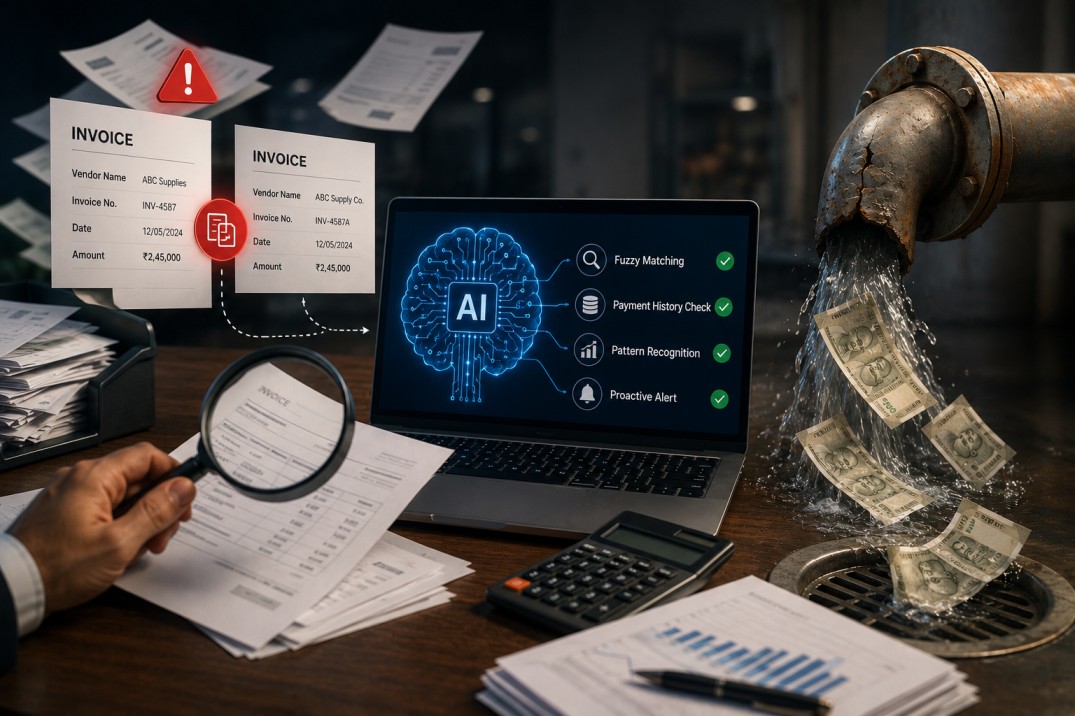
For large Indian enterprises, duplicate payments represent a significant but often unrecognized financial drain. Studies suggest that Fortune 1000 companies lose 0.5-2% of annual revenues to duplicate payments—for a ₹1,000 crore organization, that’s ₹5-20 crore annually.
AI invoice processing systems combat this through multiple mechanisms:
- Fuzzy matching algorithms: Detect near-duplicate invoices even when vendor names, dates, or amounts vary slightly
- Payment history analysis: Cross-reference against all historical payments in SAP, Oracle, or JDE systems
- Pattern recognition: Identify suspicious patterns like sequential invoice numbers with identical amounts
- Proactive alerts: Flag potential duplicates before payment execution, not during post-payment audits
Companies using specialized solutions like Fintralis for AP duplicate payment detection across SAP, Oracle, and JDE environments have recovered an average of ₹1.2-4.5 crore in their first year, with ongoing prevention saving multiples of that amount.
GST Compliance and Regulatory Advantages
India’s Goods and Services Tax regime demands meticulous record-keeping and reconciliation. AI invoice processing delivers significant compliance advantages:
- Automatic GST extraction and validation: AI systems verify GSTIN format, validate against government databases, and flag mismatches
- GSTR reconciliation: Automated matching between purchase registers and GSTR-2A/2B data, identifying discrepancies in real-time
- Input tax credit optimization: Ensures timely invoice processing to maximize eligible ITC claims
- Audit trails: Complete digital documentation with timestamps and approval chains for seamless audit responses
- E-invoice integration: Direct integration with the government’s e-invoicing portal for B2B transactions
With GST authorities increasingly leveraging data analytics to identify non-compliance, having AI-verified audit trails has become a risk mitigation imperative rather than a luxury.
Choosing the Right AI Invoice Processing Solution
Not all AI invoice processing platforms are created equal. Indian businesses should evaluate solutions based on:
1. India-Specific Capabilities
Look for systems trained on Indian invoice formats, supporting regional languages, and offering native GST compliance features. Solutions built for Western markets often struggle with India’s unique requirements.
2. ERP Integration
Seamless connectivity with your existing SAP, Oracle, JDE, Tally, or other ERP systems is non-negotiable. API-based integrations should be real-time and bidirectional.
3. Scalability and Flexibility
Your solution should handle volume fluctuations during quarter-ends and year-ends without performance degradation. Cloud-based platforms typically offer better scalability than on-premise deployments.
4. Exception Handling Intelligence
The quality of exception management separates good AI systems from great ones. Look for intelligent routing, contextual recommendations, and learning capabilities that reduce exception rates over time.
5. Security and Data Privacy
Financial data security is paramount. Ensure your solution offers encryption, role-based access controls, and compliance with Indian data protection regulations. ISO 27001 certification and SOC 2 compliance are minimum standards.
6. Vendor Stability and Support
Implementation requires ongoing support and periodic system enhancements. Choose vendors with demonstrated expertise in Indian enterprise deployments and responsive local support teams.
Implementation Roadmap for Indian Enterprises
Successful AI invoice processing implementation typically follows a phased approach:
Phase 1 (Weeks 1-4): Assessment and Planning
Analyze current AP processes, invoice volumes, exception rates, and integration requirements. Define success metrics and ROI expectations.
Phase 2 (Weeks 5-8): Pilot Deployment
Implement the solution for a single vendor category or business unit. Use this phase to refine configurations and train the AI models on your specific invoice formats.
Phase 3 (Weeks 9-16): Scaled Rollout
Expand progressively to additional vendors and invoice types. Monitor accuracy rates, processing times, and user adoption. Adjust workflows based on feedback.
Phase 4 (Weeks 17+): Optimization and Expansion
Fine-tune exception handling rules, enhance approval workflows, and integrate additional data sources. Explore advanced capabilities like predictive analytics and cash flow forecasting.
Most mid-sized implementations achieve full deployment within 3-4 months, while large enterprises with complex multi-entity structures may require 6-9 months.
The Future: Beyond 2026
AI invoice processing continues to evolve rapidly. Emerging capabilities on the horizon include:
- Predictive payment optimization: AI recommending optimal payment timing to maximize discounts while optimizing working capital
- Vendor risk assessment: Real-time analysis of vendor financial health and delivery performance to inform payment prioritization
- Blockchain integration: Immutable audit trails and smart contract-based automatic payments
- Conversational AI: Natural language queries allowing finance teams to ask questions like “Show me all pending invoices from Maharashtra vendors exceeding ₹5 lakh”
- Autonomous AP: Fully self-learning systems requiring human intervention only for strategic decisions, not operational tasks
For Indian businesses, the question is no longer whether to implement AI invoice processing, but how quickly they can deploy it to remain competitive in an increasingly automated business landscape.
Taking Action: Starting Your AI Transformation
If your organization is still relying on manual invoice processing or legacy automation systems, the time to act is now. The competitive gap between AI-enabled and traditional AP operations widens monthly.
Begin by conducting a comprehensive assessment of your current AP costs, error rates, and processing times. Calculate the potential ROI based on realistic efficiency gains—even a 60-70% reduction in manual tasks (conservative compared to the 90% achievable) delivers compelling returns.
Engage with solution providers who understand Indian business requirements and can demonstrate proven success with enterprises similar to yours. Request pilot programs that allow you to validate results before full-scale commitment.
The accounts payable revolution is here. Indian businesses that embrace AI invoice processing in 2026 aren’t just cutting costs—they’re building strategic capabilities that will define their financial operations for the next decade.
Is AP leakage costing your business?
Fintralis detects duplicate payments across SAP, Oracle, and JDE. Contingency-based — no recovery, no fee.